





Weapon Detection Systems: they are the ultimate game of “red light/green light” for students entering Elkhart High School.
As of April 13, WDS’s went into place at the front door of each school building, as well as at the bus stop entrance of the main building. These detectors, or “major annoyances” as many initially called them, have thousands of students passing through everyday.
In the morning, during passing periods (specifically when walking between school buildings), or any other time non-staff members enter the building, they must walk through the detectors and remove any metal objects from their persons. This, of course, takes time and (more importantly) patience…something teenagers tend to struggle with.
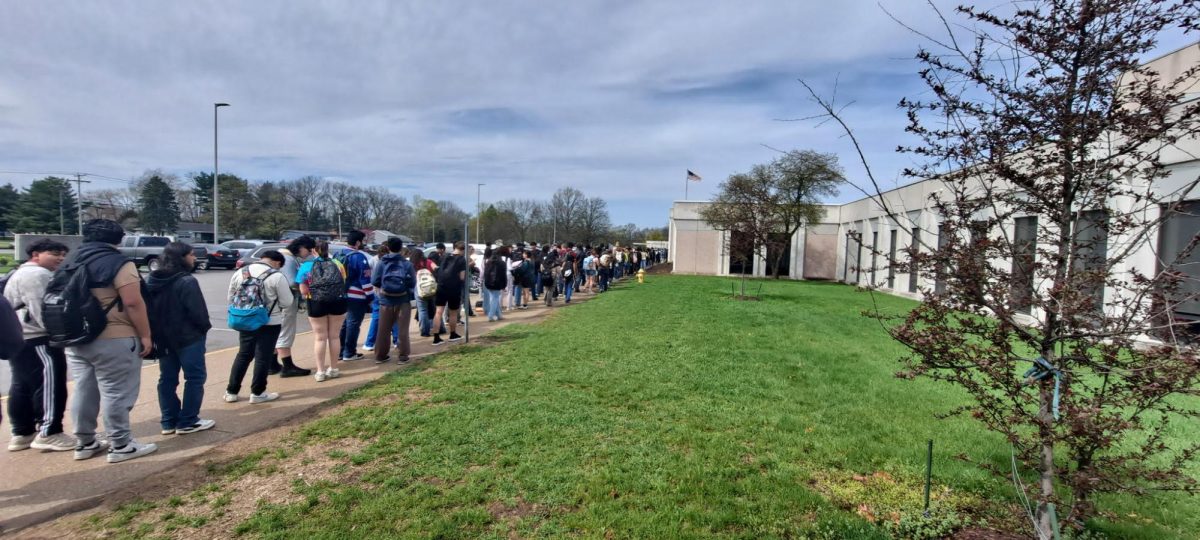
With more than 2,000 students walking through these detectors on the first day, it took about 48 minutes to get everyone inside the building. As a result, many were almost a full 30 minutes late to their classes…this on their first day back from spring break. “The second day was already down to 28 [minutes to get inside]* explains Executive Principal Mr. Phil Shults, pleased that the process was sped up a full 20 minutes.
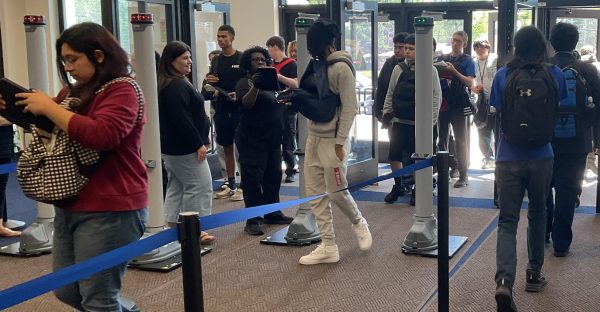 The students, making exemplary progress each day, managed to sustain a steady flow every morning by just the second week! Mrs. Jolynn Shull, bio-med teacher in the HPS building, praises them, saying, “The students have gotten much better in a short time going through the detectors.”
Initially, the students themselves had their questions, wondering if the detectors were installed just so the school would have a reason to search bags for vapes and other drug-use devices that are prohibited. As the weeks have passed, however, students have come to terms with the fact that they are in place solely for finding and removing weapons on school grounds.
But, even with the increased safety measures that the detectors provide, unforeseen dangers still exist. “I could see this causing some emotional distress,” shares Mrs. Brittany Townsley, an English teacher. “But, I think the good outweighs the bad,” she adds, noting the obvious physical safety benefits are necessary in today’s society.
Understandably, though, students get frustrated, upset, angry, and even throw full-on fits, just because the detectors beep at them. Sometimes it’s because they themselves forgot something metal within their bags. But, the main irritation among students is that the sensitivity on the detectors seemingly keeps changing.
Take the example of a keychain. One day, a keychain will be perfectly fine, as well as on the next. A full week goes by without a problem, and the student finally feels as if he or she can finally get through the detectors without a hitch. Then, all of the sudden, the detector will go off, and the student is dumbfounded on what has changed. An extra security check is made for a weapon that isn’t there, but the student has lost valuable time–all because the sensitivity on the detector isn’t consistent. This is the price one pays for safety.
But, putting aside the frustrations of just the students, even administrators feel the weight. “I hate metal detectors,” Mrs. Krista Riblet, HPS principal, admits, “but I hate school shootings more!” The burden of protecting students is something Riblet takes quite seriously. As with administrators, teachers also recognize the import. “I think about the responsibility I now hold. What if I miss something?” Townsley fearfully mentions. “It’s a little nerve-wracking to think about!”
Despite the school’s attempts to streamline the process, some remain concerned about the “bottleneck” effect that has resulted outside the main building. When students are corralled into one place and movement is limited, there is a prominent danger of someone using a weapon in this tight space, such as a hit-and-run or use of an explosive device. Students expressing this concern do not do so to spread paranoia; they simply want to raise awareness of the dangers and have it addressed.
“I think as the process improves and students become used to it,” explains Shull, “that the bottleneck issue will lessen.” Shults, on the same page, adds this: “We run into that in any high security place.” Providing an example, he elaborates. “Imagine going into an arena, right? And you’ve got all these people standing outside waiting to get in, to go through the same kind of system, you know?” It is no different at EHS. Addressing the steps currently being taken, Shults says, “I know I’m very frequently outside just to help provide a little bit of safety. If I’m not out there, somebody else is,” he adds. “I know Mr. Bird over at ETI stands at the door, too.” Shults and others have already taken the bottleneck issue into consideration and have plans in place to prevent any issues.
Beyond the additional time it takes to get in the building, the metal detectors also affect students’ and teachers’ instructional time: the main issue being student tardiness. “I have had more students being tardy than before–and they are later than ever before, especially 1st hour,” Shull laments. Agreeing, Townsley adds, “It caused the loss of instruction time.” All buildings initially extended the passing period for this. “Being in HPS,” says Shull, “we gave a little extra grace for students getting to class. Now that things are going smoother,” she adds, “there is not much difference.” Eventually, no student should be late due to the detectors, administrators state.
Currently, however, some students mention how thankful they were when the detectors were installed. If late to school, they just blamed it on the detectors. This unfair phenomenon was all but rare–and upsetting for teachers. But, even though there are students who abused this loophole, it’s unfair to say that ALL who were late and blamed it on the detectors are lying. As a result, special passes have been instituted to separate fact from fiction.
The greatest impact has been on students who travel between buildings–sometimes multiple times a day. But, there are others who have been affected minimally. Sophomore Nathan Hicks is one of them. “The metal detectors don’t have much of an impact on me, because either I don’t leave the building or I get to another building fast enough to where it doesn’t take long.”
One of the best aspects of this new system is how willing some teachers are to help out. “There’s a good number of teachers who have volunteered to be part of the Weapons Detection Systems,” Shults observes. Without the complications of having to hire extra staff to run them, more money is able to go to the school’s students.
In the end, despite human nature to complain, the consensus is that metal detectors are a necessary evil in today’s world. Students such as Hicks can see that. “I think the metal detectors are a good thing to have for more security, though it can mess up other people’s days to get to class.” From a teacher perspective, Shull summarizes the entirety of the topic in two sentences: “The kids are doing a great job preparing and passing through the detectors. I think the detectors are overall a good thing.”
Townsley finalizes it all with this: “Safety in schools is one of the top priorities. Students can’t learn if they don’t feel safe.”