



Venezuela–a beautiful South-American country–has been struggling heavily with issues of corruption for decades now. First, Hugo Chavez, and later on his successor Nicolas Maduro, who in early January of 2026 was captured by U.S. Military Forces in a tactical plan called “Operation Absolute Resolve.” Maduro and his wife remain in custody at the Metropolitan Detention Center in Brooklyn, New York, on federal drug trafficking and narco-terrorism charges.
This event has sparked renewed attention globally about the situation in Venezuela, including the various human rights violations, government corruption, and general instability of the country, sparking discussion over whether this nation is or could be considered a “failed state.”
However, the people of Venezuela themselves perhaps could give some of the best insight into this country in turmoil, providing their first-hand accounts of the situation there.
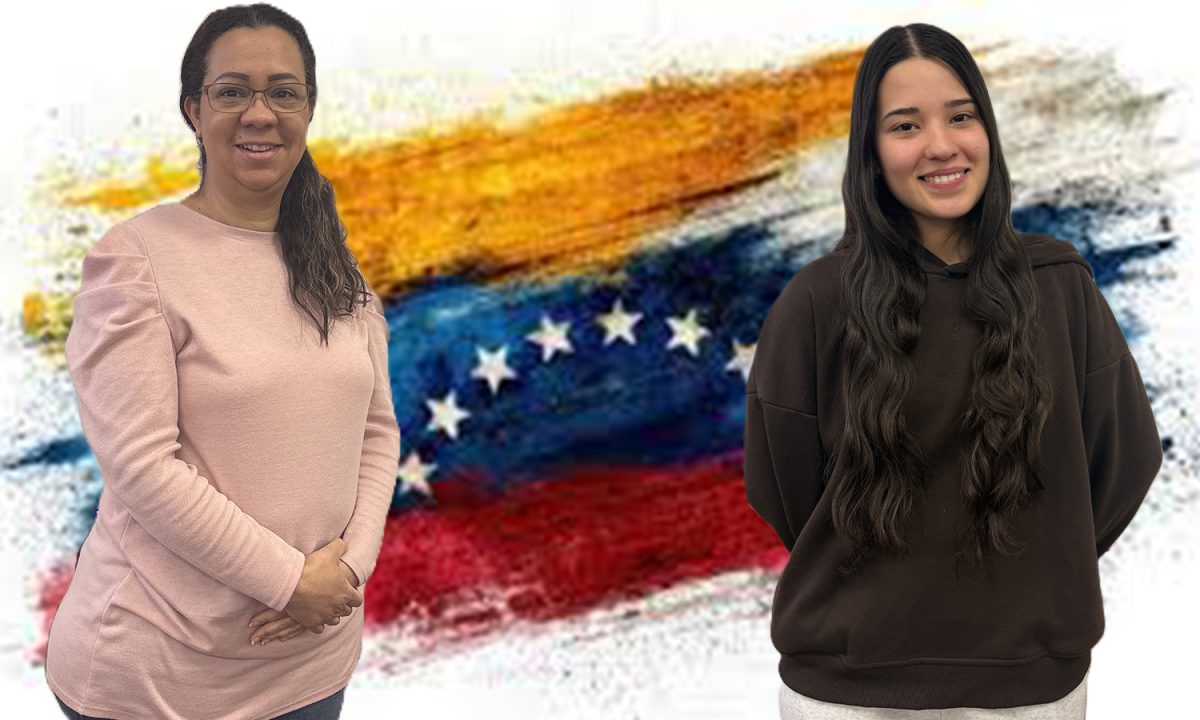
ENL teacher Sury Bengochea De Mejias, at Elkhart High School, is quite passionate about her home country. Reflecting back on how she remembers it, Bengochea says, “In terms of nature, Venezuela is beautiful–with a great variety of landscapes ranging from paradisiacal beaches, cold weather, desert regions, tropical plains, rainforests, and tepuyes.” She expounds further upon the diversity of its citizens, their delightful humor, and even their exquisite food.
Her comment about the diverse culture is also echoed through minorityrights.org: The country has a fairly diverse population with a bit of everybody from all over—not too dissimilar to the USA–with Spanish, Arabs, Whites, Africans, and of course the indigenous folk of the country.
Yet, as beautiful as its terrain is, Bengochea notes how “deplorable” the quality of life has become. “The massive migration of more than 8 million people from Venezuela–one of the largest exoduses of the American continent–is a phenomenon that cannot be taken lightly,” she insists. “This corrupted system has violated the human rights of thousands of Venezuelans, who have no choice but to find ways to survive.” In near disbelief, she adds, “I never thought I’d have to flee.”
From all accounts, it is not what lies above ground that is causing all of the chaos; it is what lies beneath. The country itself is well known as a “petrol state,” or a state that is primarily known for having a large oil supply. “It had–and still has–one of the largest oil reserves in the world,” Bengochea claims. “[Chavez] allowed foreign dictatorships like Cuba, China, Iran, and Russia to access natural resources in exchange for international lobbying and a political shield against sanctions that help them to stay in power.”
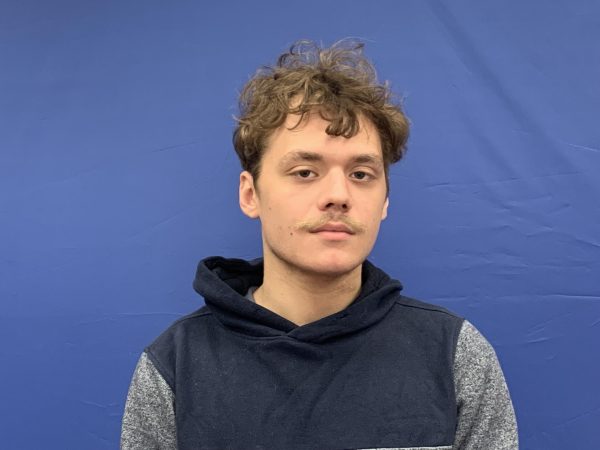
In terms of oil, it seems that, through the current hardships, the people of Venezuela have made use of what they have. EHS Senior Maria Artigas Ulloa, a native of that country, can personally attest to that. “I remember when there was no electricity; we would all kind of bond together to help each other–including making these gas candles for multiple people.” Continuing, she adds, “Some of the richer folk would even purchase generators to help power fridges and stuff to make sure food didn’t go bad fast.”
Ulloa herself was born in Venezuela, stating, “I lived in Venezuela until 2019. I moved to the USA with my family due to the government….they were threatening everyone. My mother was a doctor, an educated person, and one of the first types of people the government would go after in purges and such,” she recalls. “My dad also lost his job because the government took his workplace. His boss didn’t like that, so they fired him and anyone his boss had hired, such as my father.”
This is an unfortunate pattern with the Venezuelan government, as it is with various other similar authoritarian governments. Bengochea has stated from her experience that “[Chavez’s] government started to seize private companies. In fact, my husband worked in one of the many companies that surround Maracaibo Lake. It was seized (expropriated) by the government and transferred to Petróleos de Venezuela (PDVSA), meaning he then became an employee of the state company.” Explaining further, she adds, “the problem was, since PDVSA is government-owned, politics became involved. If you didn’t support Chavez and participate in his rallies, you would lose your job and be put on a list of dissenters.”
Another issue was–and still is–starvation. Through government seizure of properties and other entities in the country, there have been various famines and other issues arising from the government’s actions, with food insecurity being one of the main reasons people even flee in the first place.
Both Bengochea and Ulloa have had much to say about this problem. In fact, Bengochea states, “At one point, I had to wait in long lines just to get milk for my daughter. I also remembered one part of [Chavez’s] ideology was that ‘being rich was bad,’ which furthered division among the Venezuelan people.”
Ulloa adds on to this with her own reflection, stating, “It was around 2016 that the government began seizing a lot of things, such as water, electricity…everything. That is one of the reasons my family ultimately left. Leaving was difficult, as well,” she confides. “We went to the capital to get visas to go to America, but they rejected us. So, eventually we fled over to Colombia, where we finally got our ticket to the USA.”
The government’s corruption didn’t just stop on the level of signing papers and orders, but the military itself would get on the ground to confront civilians head on. Ulloa recounts: “There were times where the government would make checkpoints on well-used bridges and roads. If you didn’t pay, they wouldn’t let you through.”
Through all of these issues, it’s important to look at their roots. And, it seems one man has often been blamed for the current crisis the country faces: Hugo Chavez. “Under his term,” Bengochea explains, “he made profound changes politically and constitutionally to establish a new system called ’21st Century Socialism.’ This system–whose nature is control and obedience over freedom–allowed Chavez and his successor Maduro to stay in power for a longer period and be re-elected.”
Bengochea lived in the country under a majority of Chavez’s regime and has stated that around the time he seized power, the country was already in a state of flux, but Chavez promised to improve both the economy and the safety. He hoped the world would see him as the country’s rescuer. “[Venezuela] had manipulative leaders around the time of Chavez–leaders that promised safety. One such leader was Chavez himself.”
Chavez won by democratic election in 1998. At that time, Venezuelans did not forsee the direction in which he would take the country. It was not a “regime” yet. Therefore, everything was working as supposed. However, on July 25, 1999, Chavez started to change the laws by calling a “Constituent Assembly.” Still, the popularity of Chavez remained high. “The University where I graduated had him as the Commencement Speaker for the graduation ceremony on the 16th of July 1999,” recalls Bengochea.
Under the Chavez government, the country effectively collapsed in on itself, with his “revolutionary” ideology being not too dissimilar to that of Communist ideologies, or the ideologies of other dictatorial regimes. Bengochea even stated, in her opinion, that Chavez “ruined” the country. “He altered the constitution to stay in power, made questionable deals with foreign countries like Cuba, and even created fake elections. In fact,” she continues, “during one incident, the military wanted a coup against him. So, he simply fled to Cuba, waited things out, and then returned.”
Of course, through the storm there was resilience–times of peace and calm–as Venezuelans reflect back on better times. “I was born in 1976 under the country’s former Democratic government…before Chavez,” Bengochea recalls. “There was corruption,” she admits, “but every country has some degree of corruption. Yet at that time,” she fondly states, “it was a decent country…somewhere comfortable you could live in.”
Ulloa has her own recollections. “From what I remember,” she begins, “everyone was alright in the country before 2014/2015. I even graduated elementary there…though we didn’t have a celebration, since the government canceled a lot of celebrations around that time, including ones for kids.” Pausing reflectively, Ulloa concludes more somberly. “It was shortly after I graduated elementary that I fled.”
A decade later, the state of affairs in the country is not much better. Successfully seizing and capturing Chavez’s successor–Maduro and his wife Cilia Flores–in the raid on the country’s capital of Caracas may eventually prove beneficial. However, last month’s event resulted in an increased panic amongst Venezuelans–both at home and abroad.
Ulloa, who still has some family in the country, shares. “When the attack occurred, my family was very close to where the bombs fell since they lived near a military base. While they were inside,” she notes, “they could still see the bombs fall.”
Although the bombs have discontinued falling, the Maduro regime has not. Delcy Rodriguez, former vice president, is functioning as the country’s interim president. Other Maduro allies–Defence Minister Vladimir Padrino Lopez and National Assembly President Jorge Rodriguez, in particular–are still politically involved. Meanwhile, the Venezuelan people remain in limbo as they hope for free and fair elections to become possible.
“This government is led by a narco-terrorist, a leader of the ‘Suns Cartel,’ meaning that this is a monster with many heads,” Bengochea states. “Therefore, I argue that the removal of the big head won’t be enough, because the system is still operating–especially the torture system, and the lack of a balanced, democratically elected legal system. The capture of Nicolas Maduro was, of course, a light in the tunnel that the majority of us have celebrated.”
Thus, while Maduro awaits trial to determine his fate, Venezuelans anxiously wait to see what the future holds for their country.
More about what has been happening in the last two years:
- 2024 https://www.hrw.org/world-report/2025/country-chapters/venezuela
- 2025 https://www.hrw.org/world-report/2026/country-chapters/venezuela