






Artemis is the next big step for space exploration–but taking baby steps to complete.
As background, Artemis is the current program that NASA is implementing to further space travel, eventually setting up a moon base so that a manned mission to Mars can be achieved. This recent push comes after 50 years of no space exploration progress. In April, NASA successfully completed the Artemis II steps, allowing it to move forward with Artemis III–while the start of the final stage of the Artemis program is expected to start in late 2028.
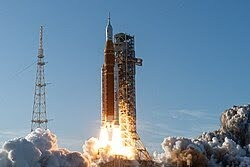 What began as one small step for man when Neil Armstrong landed on the Moon in 1969 will definitely be a giant leap for mankind if the mission to Mars is ultimately accomplished. The first step NASA took was the Artemis I launch on Nov. 16, 2022, which was a uncrewed lunar flight test. As NASA’s website says, “Artemis I was the first integrated flight test of NASA’s Deep Space Exploration Systems: the Orion spacecraft, Space Launch System (SLS) rocket, with the upgrade Exploration Ground Systems at Kennedy Space Center in Cape Canaveral, Florida.”
The mission duration lasted 25 days, 10 hours, and 53 minutes. Spectacularly, the spacecraft traveled a total distance of 1.4 million miles. And, its splashdown occurred unhampered on Dec. 11 at a speed of 24,581 mph or Mach 32. Additionally, there were sensors installed inside the ship to measure such things as radiation and vibration–necessary readings for the Artemis program to move forward. The mission was deemed a success. Now, the tue test would be adding humans to a new mission.
Artemis II was the first Crewed Lunar Flyby, taking nine Days, one hour, and 32 minutes. It launched on April 1, 2026, and splashdowned on April 10 at a speed of about 25,000 mph. Its goal was to conduct the first crewed flight test of the Orion spacecraft and the SLS rocket around the Moon. If that was the goal, what did they achieve? NASA achieved a world record for the greatest distance humans have traveled in space. Moreover, the flight crew were able to conduct essential research about the Moon.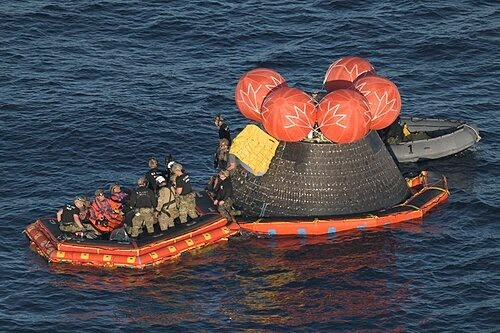
So, what’s next? Artemis III is the next big step–a mission in low Earth orbit that will test integrated operations between the Orion spacecraft and one or both commercial landers from SpaceX and Blue Origin. NASA shoots to launch in sometime during 2027. The mission type is a Rendezvous and Docking in Low Earth Orbit, which will contain humans. The goal of the mission is to test one or both commercial landers from SpaceX and Blue Origin and to test the rendezvous and docking capabilities between the Orion and the private commercial spacecraft needed to land astronauts on the Moon.
If deemed successful, Artemis IV is on track to start in early 2028, having astronauts observe and collect samples from the lunar South Pole. But, there are still more questions that need to be answered by NASA before it shoots for the Moon.