





When hearing the terms “Big Brother” or “1984,” society typically associates those with the idea of complete totalitarianism, mass-surveillance, and a general mistrust of the government. Yet, where did these terms originate?
Look no further than the 1949 novel Nineteen Eighty-Four by George Orwell, along with its more juvenile predecessor by the same author, Animal Farm (1945). The two are allegorical and politically motivated pieces of fiction that have spawned terms that have become common, ideological expressions.
Take, for example, the phrase“Big Brother.” It has morphed into a buzzword for mass-surveillance by one’s own government. Or, merely look at the very name of both novels: Nineteen Eighty-Four and Animal Farm. Both are alluded to casually as an easy way of simplifying ideas of corruption, authoritarianism, and the like to a catchphrase.
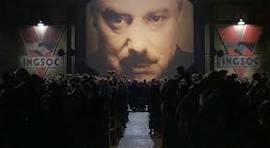
Undeniably, Nineteen Eight-Four is a giant in size–ranging between 300 to 350 pages, depending on the version. Yet, the plotline itself is of great magnitude. The story focuses on Winston, an unfortunate man living within the dystopian society of Oceania, which makes up North and South America, Australia, and the United Kingdom. The superstate is run by the totalitarian government of Ingsoc, which symbolically stands for English-Socialism, of which Winston is a member.
Conversely, Animal Farm is much shorter–only around 70 or so pages–and is often considered a more “dumbed down” and “elementary” version of or for high schoolers. The book itself centers on a farm, in which the animals–led by the “Pigs”–revolt against the human farm owners, taking over the farm and declaring it their own. However, power gets to the heads of the pigs, and they transform into dictators in their own right.
Despite both works being decent works of fiction, both offer warning themes that one can attribute to his or her own true government, regardless of what nation an individual lives in–as no government is perfect, not even the most democratic or free a government. However, Orwell is clearly targeting the rise in socialism and communism in his time.
In Animal Farm, one of the more notable lines is this: “All animals are equal, but some animals are more equal than others.” Here, Orwell is poking holes in the socialist philosophy. First and foremost is the infeasibility of actual equality, as the greed and competitive nature of mankind inevitably gets in the way of such an admittedly benevolent and noble idea. EHS English teacher Mrs. Tamara González, who has taught Animal Farm explains, “A theme that I noticed is the impossibility of true equality.” Qualifying that, she adds, “Perhaps our differences make our society better.”
Not surprisingly, Nineteen Eighty-Four also touches on this theme, particularly with how the society of Oceania–the totalitarian superstate in the novel–divides its people up into three different classes: the Inner-Party at the head of the pyramid, the Outer-Party as the neck, and the Proles as the body. Each represents the elite, middle-class, and the proletariat, respectively.
The frightening reality of this, however, is that these ideas are not just fictional; they are based on very real ideologies and their practices. Nineteen Eighty-Four is based loosely on Nazi Germany and the Soviet Union under Stalin, while Animal Farm is based more on the Russian Revolution of 1917 and formation of the Soviet Union.
Thus, both books have often been viewed as political warnings. “Orwell was trying to warn us that there can be no utopia because of the frailties of human nature,” González explains. “In other words, we can’t create a perfect society, because the negative aspects of the human psyche–such as greed and envy–will muck it up.”
However, these aspects did not die in the 20th century. In fact, some still persist across the globe to this day. The “hermit kingdom” of North Korea, for example, has often been compared directly to Oceania and the Ingsoc (English-Socialist) party from Nineteen Eighty-Four. This is attributed to the country’s blatant corruption, seemingly complete dictatorship, and closed-off nature to the rest of the world.
However, aspects can be found in every country. In fact, many countries–including the United States and the United Kingdom–continue to have issues with poverty and separation via classes, though this is often more of an economic issue in the West.
In the end, there still lies one ultimate question: Whose society was worse? The ultimate dystopian nation of Oceania, run by the corrupt Ingsoc who has managed to convert an entire part of the world into a totalitarian superstate? Or, the corrupt, post-revolution farm in Animal Farm, run by the Pigs who started as revolutionary leaders, just to become dictators in their own right? González says, “Ingsoc is worse.” Orwell may very well have agreed.
Ultimately, it becomes a matter of motivation, writing, and personal opinion.
Animal Farm Releases in Theaters on May 1
Coming out on May 1, 2026 (in the United States), is a film adaptation of Animal Farm, directed by Andy Serkis, and starring Seth Rogen, Gaten Matarazzo, Kieran Culkin, Glenn Close, Laverne Cox, Steve Buscemi, Woody Harrelson, Jim Parson, Andy Serkis, Kathleen Turner, and Iman Vellani as the titular cast of the novel.
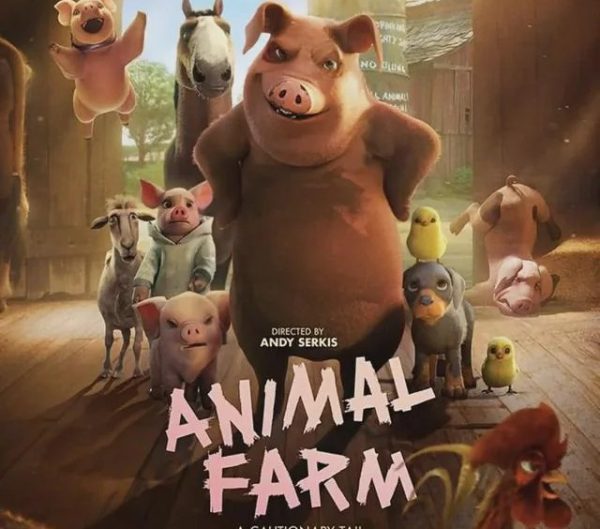 However, the film has stirred up some debate, already receiving fairly unfavourable reviews from critics and audiences who viewed the film early at the Annecy Film Festival in France.
This criticism centers on the film’s completely different tone from the novel, taking on a more juvenile, less complex, and ultimately easy-to-digest tone that seems to abandon much of the original societal-warning themes and plot points that George Orwell had intended.
The ending is the most controversial part, changing the novel’s ending, which originally involved the Pigs becoming almost indistinguishable from humans–Orwell’s point that neither man nor beast can rise above his true nature. The more politically correct 2026 version apparently features an almost painfully typical ending that involves good triumphing over evil, with a lack of any form of nuance.